You’re going on a cross-country trip. Will you be traveling by plane, train, bus, car, or bicycle?
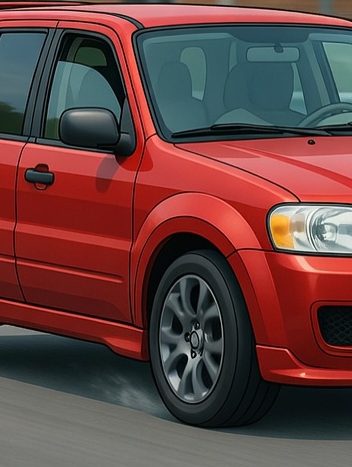
That’s right, my car is a red Ford Escape, equipped with a V6 engine. 2003 production, with 135,200 km mileage on it (about 84,000 miles). Sorry, I used Grok to edit the image of my car. I wanted to wipe out the license plate, but I thought that cartooning my car would be more fun.
HOW CONFIDENT AM I DRIVING AN OLD CAR CROSS-COUNTRY TRIP?
1000% Confident! And that’s not a typo.
Here’s something people don’t understand about my Ford Escape: she was never meant for short trips. I rarely drive her under 50 kilometers — that’s the minimum. This car was built for the long haul, and that’s where she truly comes alive.
My longest single stretch? Over 500 kilometers between breaks, with total trips regularly hitting 1,000 to 3,000 kilometers. Not in a new car with lane assist and adaptive cruise control — in a 2003 Ford Escape with 135,000 kilometers on the clock and plastic trim held together by hope.
And you know what? I wouldn’t trade it for anything.
There’s a feeling you get at 100-120 km/h on an open highway in a car this old — something modern cars have engineered away. The engine hums at a frequency you can feel in your chest. The suspension reports every imperfection in the road, reminding you that yes, you are actually driving, not just sitting in a moving living room. The wind leaks in through seals that probably should have been replaced years ago. Your passenger falls asleep to the rhythm of it all. And somewhere between the second and third hour, the car stops being a machine. She becomes a companion.
The funny thing is, these memories feel like they existed before I made them. Like driving this car unlocked something that was always supposed to happen. That probably sounds ridiculous. I don’t care.
The Bali Trip That Almost Got Me in Trouble
Let me tell you about the time I took the car to Bali.
I was there to learn the roads. I have this thing where I need to memorize a place — every street, every corner, every shortcut, every dead end. I can’t just visit somewhere and call it done. I need to know it. And the only way to know a place is to drive through it.
So there I was, cruising back and forth through neighborhoods in a bright red Ford Escape — not exactly the most inconspicuous vehicle on the island. I didn’t remember exactly what I was looking for. And after a few laps, people started to notice. The same red SUV, circling the same blocks, over and over. I saw the curious glances and heard the hushed tones. A couple of guys on motorbikes started paying a little too much attention.
I took the hint. Perhaps their intention was to assist, but I was simply trying to avoid any attention, positive or negative.
Instead of pushing my luck in the lowlands, I pointed the Escape uphill — toward the Kintamani area, the volcanic highlands in the northeast of Bali. If you’ve never been, picture this: you climb for about an hour through narrow roads lined with temples and monkeys, and then suddenly the treeline breaks open and you’re staring at Mount Batur across a massive caldera lake. The air drops about 10 degrees. The tourists thin out. Everything gets quiet.
I parked the car, found a small coffee shop overlooking the valley, and ordered a Kintamani coffee — one of the best single-origin coffees in Indonesia, grown right there on the volcanic slopes. I sat there for what felt like an hour but was probably two. Just the view, the coffee, and the faint ticking of the Escape’s engine cooling down behind me.
When the sun started dipping, I drove back down to Kuta in the dark. The descent at night is something else — hairpin turns, barely lit, the headlights carving through fog. The Escape handled it stubbornly and without complaint.
TECHNICAL SPECIFICATIONS THAT’LL BLOW YOUR MIND
What I love about this car is the engine. A remarkably potent engine that outlasts every other component in this car. The 3.0 V6 has been called one of the most reliable V6s of all time by automotive enthusiasts, with owners reporting 300,000+ miles on proper maintenance. The 3.0 V6 Ford engine even lasts longer than my Toyota RAV4 engine.
You might be wondering why I could say that. You also think that I’ve only used it for such a low mileage to judge the engine. But here is the simple fact: my Toyota RAV4 has 150,000 miles on it and has already lost about 75% of its original performance within 8-10 years of use — it needed an engine overhaul and tuning up just to stay drivable. The Ford Escape 3.0 V6? Still running strong on its original setup. No overhaul, no major tune-up. Toyota makes incredible small engines — but Ford’s big V6 simply refuses to die.
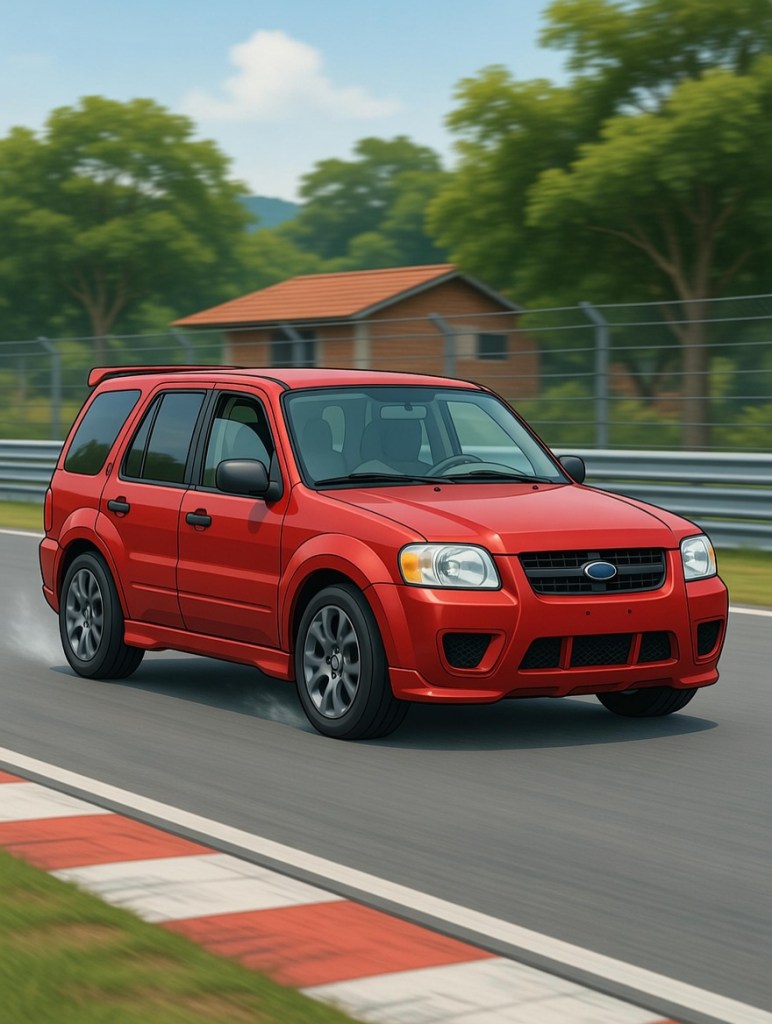
The mastery of American engineers in high-capacity engines is truly remarkable (cause.. you know.. everybody loves muscle cars). If you chose a small-capacity American engine — like the Ford 1.5L or 1.6L EcoBoost — you might end up saving 97% of your gas money, because your car will spend most of its time in the workshop. The EcoBoost engines have a known design flaw where coolant leaks into the cylinders, leading to catastrophic engine failure. In other words, you will never use that stupid, broken, tiny engine car. I might exaggerating it a little bit, but if you want a small-capacity engine for daily car, just pick a reliable Toyota. Japanese is the master of small-capacity engines.
However, beside a powerful engine, this Ford is fragile. The manufacturer used weak plastic components and adhesives scattered all over the car — interior trim, door panels, exterior shields, you name it. This isn’t just my experience; Ford Escape forums are filled with owners reporting cracked interior trim, headliners falling down, door panels peeling off, and mirror glass detaching from its housing. One owner described the root cause as ‘weak plastic clips, a poorly held together center section, and trim panels too tight to the frame.’ Chinese-made plastics feel far superior to what Ford put in this car.
Because Ford mixed weak and strong materials in one car, she gives me love-hate relationship. I really hate it that my car needs maintenance outside of her regular schedule (because of weak components). But the sight of open roads ignites a thrilling sensation within me, a powerful passion that makes me long to drive my Ford Escape 3.0 V6 in Red.
“Isn’t Your Car Too Old for Long Trips?”
My first instinct when someone asks this is to tell them to go away. (I’m being polite here.) or just say “fukc* of*!!” (I’m being most polite here.)
But fine, serious answer: you need to know your car.
Back in the day, manufacturers built things to last. The cars were heavier, simpler, and designed with durability as a selling point — even if that sometimes meant the company went bankrupt because nobody needed to buy a replacement. The ones that survived figured out how to make money selling parts, or pivoted to making faster, flashier models. But the bones of those old cars? Solid.
Now? Manufacturers use what I call the disposable method. A car built today is essentially designed to start falling apart after five years. Sure, you can drive it past that mark, but your maintenance costs will skyrocket. The electronics fail, the turbos give up, the infotainment screen goes black, and suddenly you’re spending more on repairs than your monthly payment ever was. It’s not a bug — it’s the business model. They want you back in the showroom.
With an old car, the math is different. Yes, things break. But the things that break are simple. A plastic clip snaps? Replace it yourself for a dollar. A seal leaks? YouTube and a weekend. You learn to tinker. You learn to listen to your car — literally. I can hear when something is slightly off in the Escape’s engine note from the driver’s seat. I know what every rattle means. Modern car owners don’t have that relationship with their vehicles. They have a dashboard full of warning lights and a dealership appointment.
Is my 2003 Ford Escape “reliable” in the way a Toyota Prius is reliable? No. But I know every inch of this car. I know what she can handle and what she can’t. I know when to push her and when to let her rest. And that intimacy with the machine — is worth more than any warranty card.
So if you’re thinking about taking an old car on a long trip: do it. Learn your car. Listen to your car. And if someone tells you your car is too old — well, you already know what I’d tell them.


 Focalvoid
Leave a comment